

Fill-flash
There are a couple of main differences in using fill-flash versus a reflector for adding light to a foreground element. One is that with a reflector you can better aim where the light is going and you can see in the viewfinder just how it's going to look. The other is that a reflector tends to concentrate the light to one narrow area, whereas flash tends to spread it more evenly.
Both fill-flash and light from a reflector are subject to the same inverse-square law of nature that basically says light intensity falls off the farther it has to travel from the source. So don't plan on lighting up things in the foreground and things in the mid-ground with the same intensity of light. In fact, just concern yourself with the foreground. The point of using fill-flash is to put just enough light out there to fill shadows, while still preserving the fact that there are shadows. If you eliminate the shadows with the flash then things start looking unnatural.
When light is needed in a relatively small area, a reflector is often the best choice. When you need to cover a broader area, then fill-flash often works best.
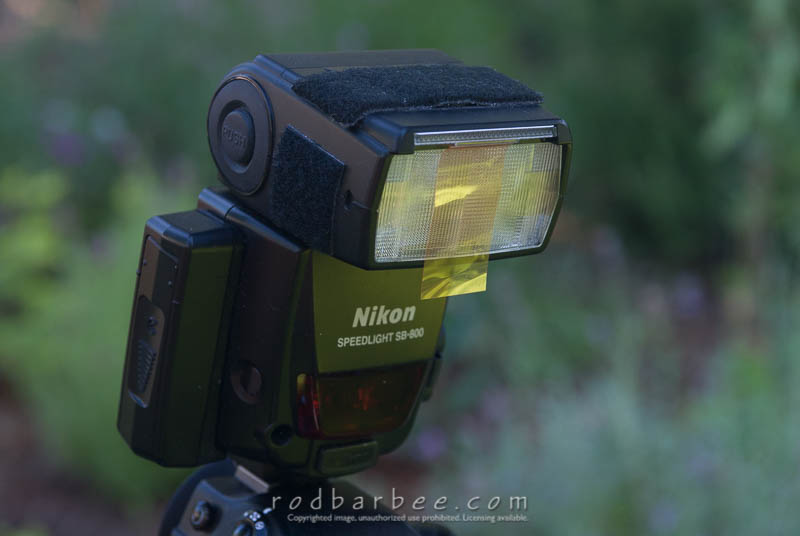
The thing to keep in mind when using your flash is the fact that the light coming out of the flash is about the same color temperature as that of noon-time sunlight. If you're photographing at noon on a sunny day then don't worry. But if you're photographing a sunrise or sunset, then the color of light from the sun is going to be different than that of the flash and you'll end up with a foreground lit with a different color light than the rest of the scene.
 It's pretty easy to match the light from the flash with light from the sunset or sunrise. In fact, you really don't need to exactly match it; all you really need to do is tone down that mid-day color coming from the flash. You can get "sunset" gels from any well-stocked camera store. Another thing you can do is to simply use an old 81A or 81B warming filter. You remember those. We used to use them in the old days of film. I'm sure you have one gathering dust in a closet or serving as a coaster. Place the filter or the gel over the flash head. You can control the amount of warming by using only part of the filter or just a strip of the gel.
So just how much light do you need for fill-flash? Back in the film days we had a rule of thumb: set the flash in TTL mode and the flash compensation at -1.7. We didn't really use the fill-flash mode on the flash as that decided things for us and, being control freaks, we didn't want that to happen.
Here's how I would use fill-flash. First I determine a manual exposure for the entire scene using whatever method worked. I usually used spot metering back in the days of film. After I determined the overall exposure, I switch the metering pattern to Matrix (that's Evaluative for you Canon shooters), set the flash on TTL with compensation on the flash set at -1.7, and shoot.
Today, with my Nikon D810, unless there are other factors like a very bright sky that will require the use of a graduated ND filter, I'd probably use my Matrix meter to determine the overall exposure and set the flash at about the same compensation as with film (-1.7).
Of course, today we have those handy LCD screens on the back of the camera to tell us if the fill-flash worked the way we intended it to. Back in film days I would bracket the flash compensation just to make sure. Nearly every time, -1.7 flash compensation was the right choice.
In the pair of pictures below you can see the dramatic difference fill-flash makes. Dark shadows in a foreground are where landscape pictures go to die. If the viewer can't make visual sense of the foreground, then the rest of the landscape doesn't matter and you might as well have not included a foreground at all.
Nikon F5, 24mm, f/22, shutter speed not recorded. Fill-flash on second picture: Nikon SB-28, TTL, -1.7 compensation.

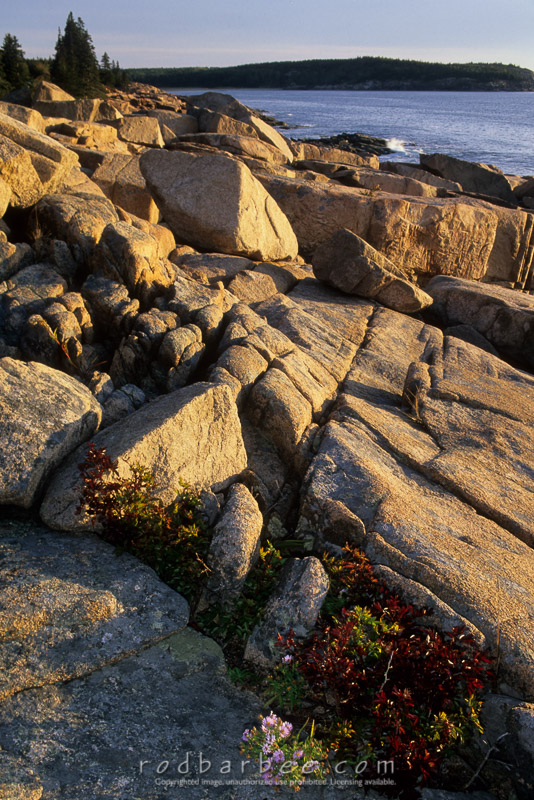
Atlantic shore at sunrise from near Otter Cliff. Acadia National Park, ME