

Exposure Challenge
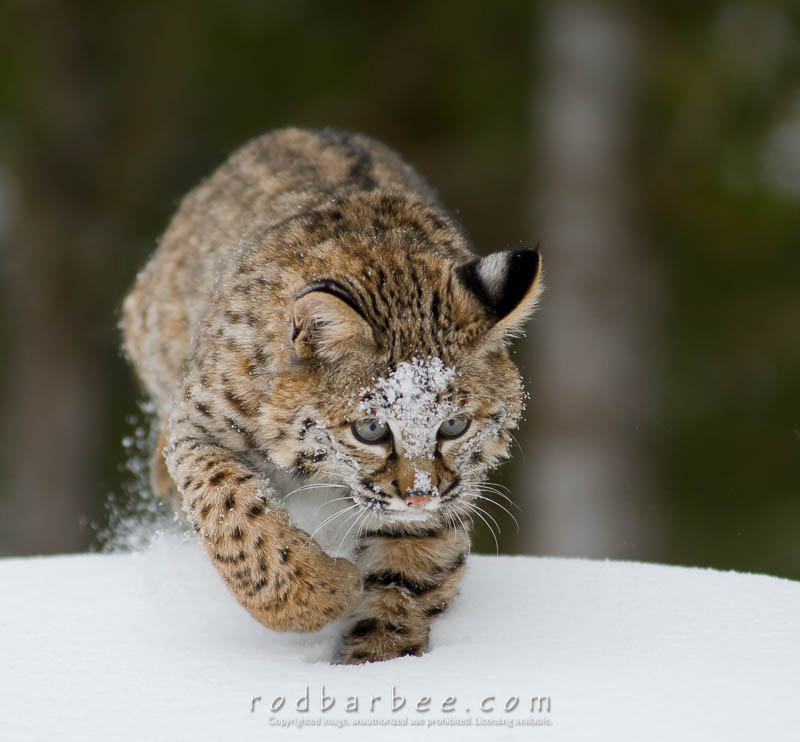 During this shoot one winter at Triple "D" in Kalispell, MT, I came across a situation where, by trying to simplify the exposure process, I actually just completely complicated it. Usually, when photographing wildlife, Aperture Priority exposure mode works best. This is because animals are typically moving fast and there's no time to take a spot meter reading. Plus the lighting situation often changes as you point your camera in different directions.
But if you throw in some bright snow and dark trees, then shooting in an auto exposure mode can make your photographic life a misery.
We had a situation that really illustrates this point. We were on the shade side of a hill, the ground is covered in snow and there are dark green evergreen trees in the background. We were photographing a small bobcat. When the bobcat was on top of the hill, the background, and the dominant tonality of the scene, was the dark green trees. When the bobcat came down the hill, he was surrounded by the white snow. This is a nightmare scenario for automatic exposure (I was using Aperture Priority).
As you may or may not know, the camera's meter assumes that everything is of average (or 18%) reflectance and will give you settings to make that true. So if the scene is mostly light in tone, like a snow bank, the meter will assume it's supposed to be medium and will give you settings to make it that way. That's why snow often comes out too dark in your pictures. The opposite is also true. If the scene is mainly made up of dark things (like say, evergreen trees) the meter will try to make those medium too, making everything brighter than it is in reality.
At first, I tried dialing in compensation for each situation, but since bobcats move rather quickly, I constantly needed to change compensation every time the kitty moved. I finally had that "smack-my-forehead-with-palm-of-my-hand" moment and realized that the light itself was not changing and I could just set one exposure and leave it alone. So I switched to manual mode and spot-metered the dark trees, setting the meter to about -1 so that the dark trees would stay dark. I then moved the spot meter down to the snow and, without changing any settings, saw that the meter indicated about +1 2/3 to +2, which would make the white snow very white, and maybe even a little too white. The setting to make the snow about +1 1/3, preserving detail, also gave me trees that ended up between -1 and -1 1/3. This way, nothing would be too dark or too light. The exposure setting ended up being 1/400 @ f/3.5 for both the trees and the snow. Duh! I subsequently shot the rest of the session with manual exposure at these settings.
In the pair of pictures below, both were taken using aperture priority with matrix metering. The first image, (cat looking to the left) was shot without any exposure compensation dialed in. As far as the influence of the scene on the exposure goes, you can see that it's nearly split between the snow in the foreground and the dark trees in the background, with the slight majority going to the trees. Because of this influence, you can also see that the scene is a little too bright, as evidenced by detail loss in the snow. Remember, the meter wants to make everything medium.
The second picture, a much better composition by the way, puts the cat and the snow in the bottom of the frame, giving the dark trees the greatest influence over the exposure. This required exposure compensation of -1 1/3 to preserve detail in the snow. It could have been slightly darker to preserve more snow detail, but this works.
What I want you to notice is the exposure differences that automatic exposure will give you for basically the same situation in the same light. Had I not dialed in -1 1/3 stop exposure compensation in the second picture, the exposure would have been 1/160, one stop brighter than the first, already slightly too bright picture. The snow would have been completely blown out and the cat would have been over exposed. And the dark green trees would have been medium grayish looking trees. Ugh.
Nikon D200, 80-200mm f/2.8, no processing, these are as they are off the camera.
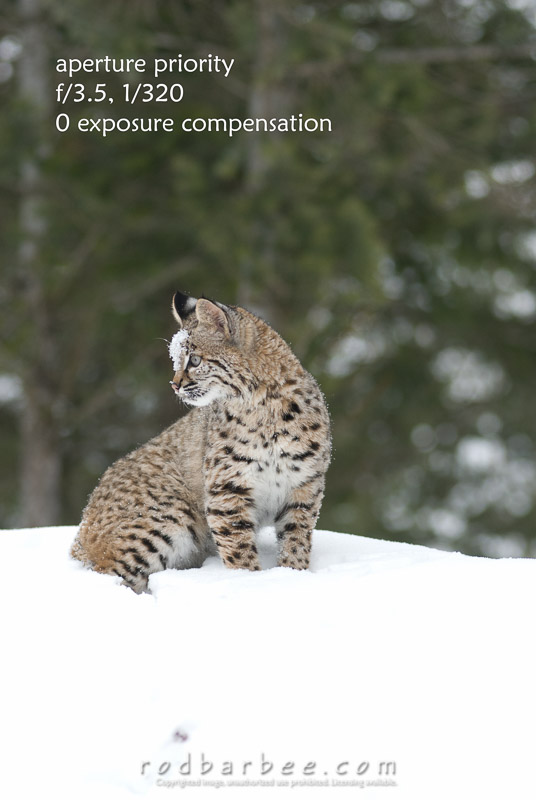

Bobcat, controlled conditions. Since the light itself isn't changing, manual exposure works best in situations like this.