I’d seen plenty of pictures of white dunes, Yucca, pink skies. And I saw all of these. What I didn’t expect was how easy it was walking on the sand; Death Valley is a much greater challenge. What I didn’t expect was the relatively small area of the park that’s immediately accessible. The one road into the park isn’t all that long.
Another thing I didn’t expect was the lack of restriction on where you can walk. Basically, you can walk anywhere. That means you can park at a pull out and just start heading in. Which is what you need to do to avoid all the tracks in the sand you’ll find close to the road. But get off the road and walk in for 10 -15 minutes (in some cases, a lot less than that) and you can find pristine areas.
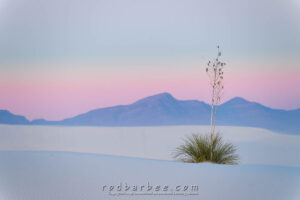 Cliff and I arrived a couple of days before the workshop began to do some scouting and to confirm our permit with ranger Kathy. Kathy gave us a few suggestions of where we might easily find some un-tracked areas so we set out to see what we could find. It didn’t take us long to find a nearly pristine area that we dubbed our “Yucca Garden,” which was a relatively small area of nicely shaped Yucca, clean sand, mountains in the background and lots and lots of subjects and possibilities. We came back the next morning to scout and photograph the sunrise. That cemented our first impression of this spot being a photographic gold mine.
Turns out our group agreed. So much so that they wanted to visit it for three out of our four sunrise shoots. Each morning presented different light: brilliant sunrise colors in the clouds one morning, dark and moody clouds the next, clear blue skies on the last. And each visit gave us the opportunity for new images and different takes on previously photographed subjects. The images just got better and better.
Revisiting a location multiple times always pays off. Usually that means returning to a location over an extended period of time; it rarely happens in the few days of a workshop. This experience dramatically demonstrated why you go back to locations again and again.
White Sands is not a place with an “iconic” subject, like a Half Dome or a Mt. Rainier. You need to take some time to look around and notice what grabs your attention. What I always find amazing about photographing a place like White Sands with a group is the diverse interpretations of what we all see in front of us. During critique sessions we saw some amazing pictures. Yes, some were similar to others (same Yucca, for example), but most were dramatically different and inspired everyone to want to try something else during the next outing. I love that synergy that a workshop can produce. And we had a great group of folks and the group really clicked.
Cliff and I had a small group, which is what we prefer. Small groups contribute to group cohesion and camaraderie. Small groups mean you don’t have to “compete” for a spot. They mean you don’t have someone always wandering into your composition. And they mean you can make good friends that you’ll want to travel with again. Oh, and it’s easier to remember four or five other names rather than nearly a dozen!
I really enjoyed my first trip to White Sands and have a feeling I’ll be going back. If you’d like to join me for a workshop, drop me note by clicking on the contact link in the menu above and I’ll add you to the notify list.