 In early December, Cliff Zenor and I conducted a workshop at Bosque del Apache National Wildlife Refuge. It was my first trip there but Cliff had visited before. We had a small group of folks, all eager to witness and photograph the birds of Bosque.
One thing we kept hearing from frequent visitors is that the water levels were very low this year and that there weren’t as many birds. If that’s the case, then when things are normal it must just be stupendous, because I thought it was simply amazing.
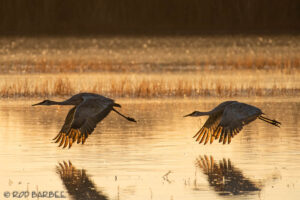
Bosque del Apache is a spectacle. Flocks of Sandhill cranes and Snow geese along with flocks of Red-wing and other blackbirds. Plus ducks! It’s also a spectacle of humanity with photographers crowding the most popular viewing points. For the most part, everyone there was polite and considerate.
Every morning we were up and out well before sunrise just so we could find a good spot along the “Flight Deck” pond and get ourselves ready. We had plenty of time to get ready, waiting in the dark and the cold. Morning temperatures all week hovered just below or just above freezing. Hand and toe warmers were popular. Once the sun came up things got better and our late afternoon to sunset shoots were very comfortable. And I’ve got to say that New Mexico sunrises and sunsets can be amazing. We had several of each. I don’t know if what we saw was normal, but I hope I’m not disappointed with merely one or two spectacular sunrise/sunsets next time I go.
During the workshop we practiced focusing on birds in flight, using auto-focus groupings, pan-blurring (where you use a relatively long shutter speed-around 1/15 second-and panned the camera while trying to keep the subject in focus) and photographing behavior and not just portraits and birds in flight.
With all the opportunities presented and the number of pictures one can take, it’s hard to not come away with at least a few great images. And from what we saw during critiques, many great images were made.
The equipment I used during this trip were Nikon D810 and Z6 bodies along with my Nikon 28-300 f/3.5-5.6 G AF-S VR, Nikon 300 f/4 AFS, and Cliff’s Nikon 200-500 f/5.6 AF-S VR (Which I borrowed. A lot.). I often had my TC-14B teleconverter attached to either the 200-500 or 300 f/4. I also pulled out my Nikon 16-35, but didn’t use it very much at all.
I would often have the 200-500 on the tripod attached to one body with the 28-300 attached to the other body connected to a shoulder strap. That way I could react quickly when I needed a wider lens to photography birds flying close to us.
Cliff usually opted for his Nikon 500mm f/4 and Nikon 24-120. Many people we saw were using 600mm lenses, including our friend Jack Dykinga, who we ran into during our first day of scouting and several mornings during the workshop. He managed some incredible images, which you can find on his Facebook page.
Cliff and I arrived a couple of days early and made a stop on the way back from our White Sands workshop that we held the week after the Bosque workshop. All in all, I made about 7000 bird images, which I’m in the process of culling down to a much, much smaller number. Way smaller. Hopefully just a few hundred at most. That takes some discipline and ruthlessness though. I’ve got a lot of work ahead of me….