

Using your histogram in the field
I've been shooting with digital cameras for over ten years now. They keep getting better and better. And I'm still amazed at the range of light they can capture as compared to slide film. I don't know if that says something about how I might still be stuck in seeing like film sees, but there it is.
In slide film days I would have needed to use a graduated neutral density image to make a good exposure of this scene. The problem with using one of those filters in a situation like this that there's very little time to set it up. The animals are moving and you need to be able to shoot quickly. Plus this was taken hand held, making it doubly tough to use a graduated filter.
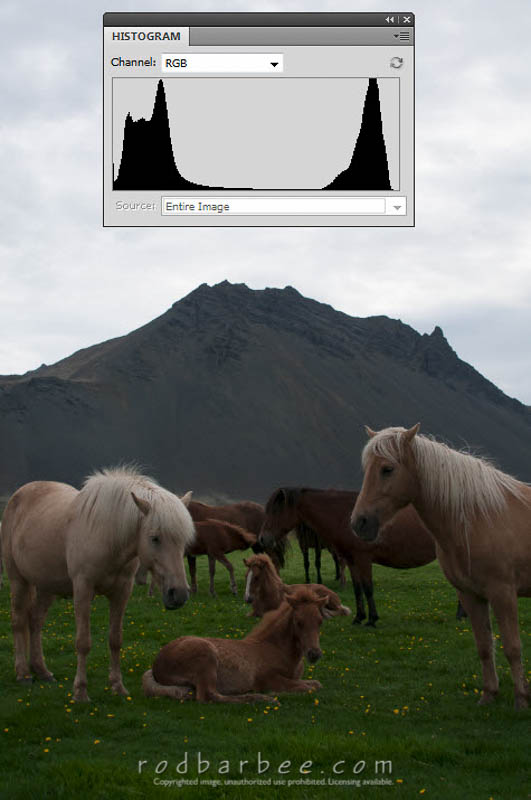
Fortunately, with today's digital cameras, a grad filter isn't even needed for a shot like this. What is needed is an understanding of how to use the histogram information shown on the back of the camera. In this case, the histogram shows that the entire range of light has been captured in one shot. By exposing "to the right" to the point that the sky doesn't blow out (become too over exposed), I'm ensuring that I'm capturing as much information as possible for post processing.
This is as easy as taking a test shot, looking at your histogram, and making any needed adjustments. Which is just what I did. I took a test shot, saw that there were some blinkies and that the histogram was butted up against the right, dialed in -1/3 stop exposure compensation, and shot again.
Here you can see the histogram with the final shot. Now this final shot isn't all that appealing, with the foreground and horses appearing under exposed and the sky appearing over exposed, and it certainly doesn't represent the scene that my eyes could see. But I have captured the entire range of light in one shot and that means I have room to work on it and to bring it back to what I was seeing at the time.
After importing into Lightroom I was able to apply a couple of graduated filters in the Develop Module to tone down the sky and to open up the foreground, adding a bit of clarity to the clouds as well as the horses. I then adjusted highlights and shadows for the entire image, ending up with the "after" picture below.
- Nikon D300, 28-300 AF-S VR lens
- Aperture Priority with Matrix Metering and -1/3 stop automatic exposure compensation
- 1/1000 sec at f/8, ISO 640
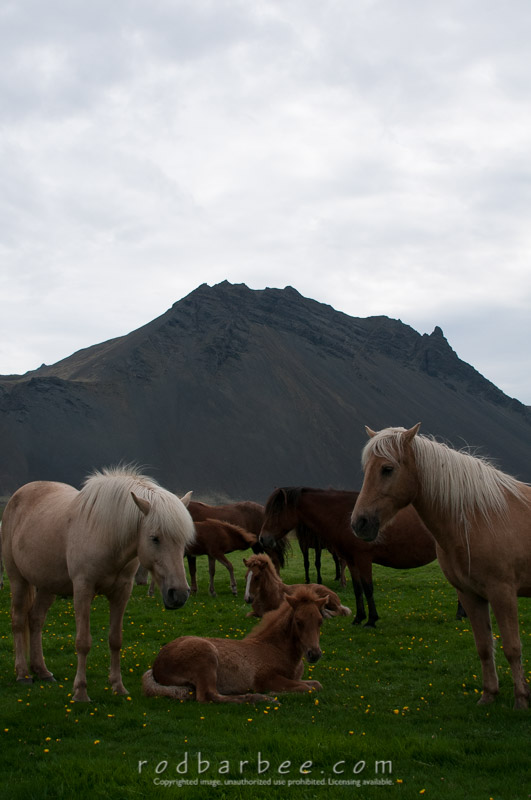

Icelandic horses at Lystidalur Farm